
Before we look at today’s pencil, a quick recap for those not already up to date – B. S. Cohen makers eventually became Arthur Johnson makers. Arthur Johnson eventually merged with E. Wolff & Son and became the Royal Sovereign Pencil Co.
Let’s look at the prize pocket pencil. It appears that Cohen were particularly proud of this model, so it got quite a lot of advertising column inches.

It’s a small pencil, thinner and shorter than a typical pencil. Round barrel as usual for this time period.
The Journal of the Royal Society of Arts Volume 13 from 1865 contains a great illustration of the pencil. We can see they came in standard graphite and then three different solid ink colours (i.e., indelible). The example I have has the red core.

The Stranger’s Guide to Dublin of 1866 helpfully informs us of the pencil and point protector’s patent – 1863. I think therefore it would be safe to assume that we can take this as a good approximate earliest date for the purposes of dating.
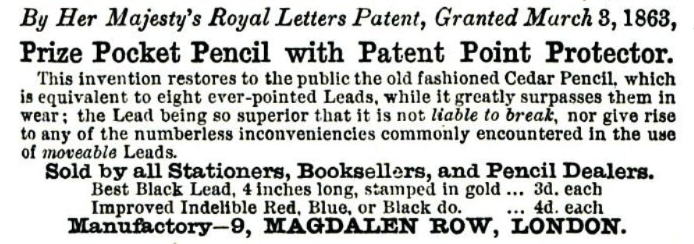
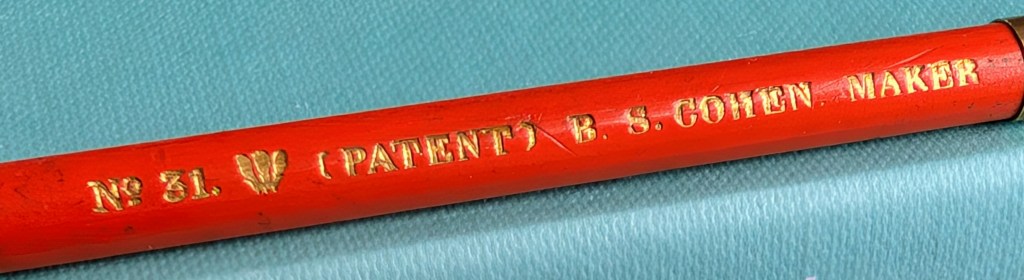
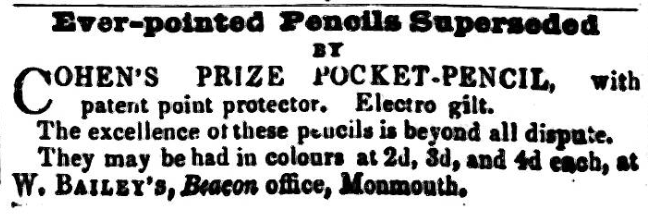
Cohen were quite specific with their advertising. For example, we can see from the advert within the Monmouthshire Beacon of 26 May 1866 that they really say the prize pocket pencil as a direct competitor for the ever-pointed pencils of the day.
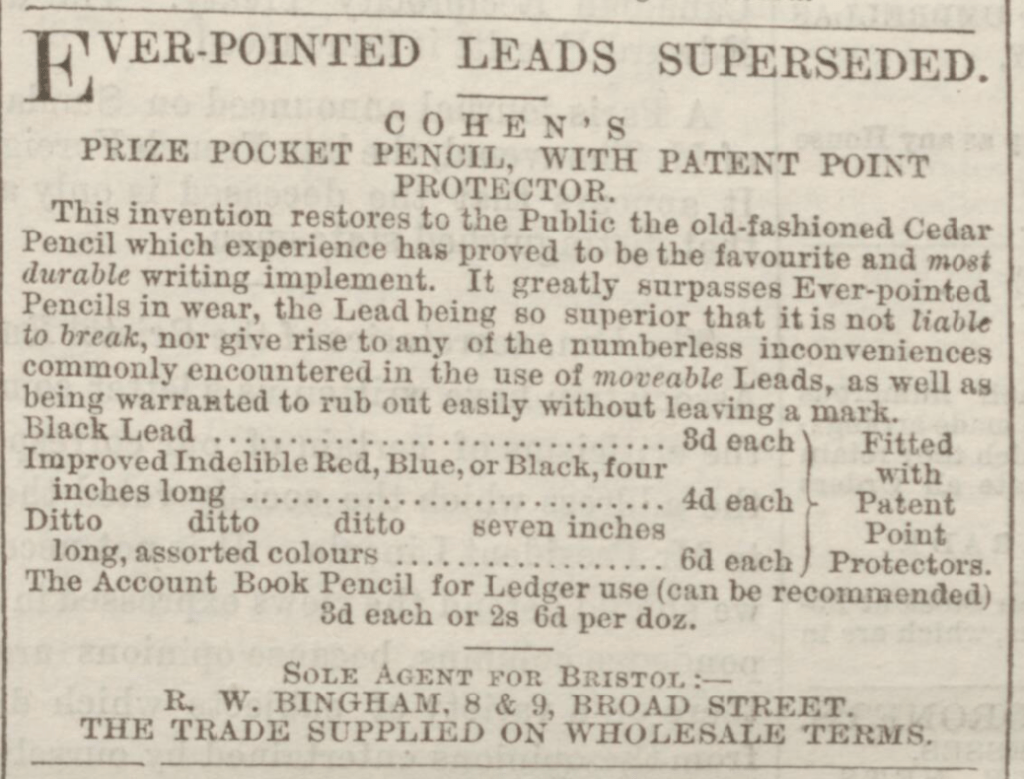
The below article from the Western Daily Press of 31 January 1865 gives us a bit more info. Again we can see that Cohen was really pushing the prize pocket pencil as a superior alternative to the ever-pointed pencils.
Here is a close up of the prize wining point protector. Honestly, it’s pretty much like every other point protector, yet Cohen still managed to get it patented and win awards.

A quick check in the London directory and we can see that the pocket pencil was indeed multi prize winning, ahieving a rather impressive set of results from the international expo’s and fairs:


The pencil has a nice end cap – not uncommon on pocket pencils. Whilst some indelible pencils had end caps so they could be held in your mouth without causing any issues, pocket pencils tend to have end caps for decorative reasons. With these old pencils, plastic wasn’t around yet so the end caps are typically bone or in the case of some particularly fancy models (unfortunately) ivory.

I’ll keep my eyes open for further examples, it would be nice to have the complete set of four for my collection, but that really could take a very long time to complete!

 pencilfodder.com
Leave a comment