
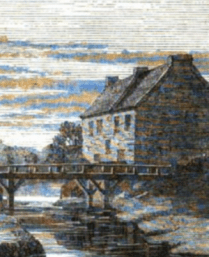
B.S. Cohen Ltd was one of the founding companies of the Royal Sovereign Pencil Co Ltd (via Arthur Johnson Ltd) along with E Wolff & Son Ltd. Before B.S Cohen Ltd was incorporated in 1904, the company operated as a traditional partnership (stylised as ‘B.S. Cohen Maker’) and their pencils don’t turn up too often, particularly the very old examples. I have a number of really good examples of early Cohen pencils in the collection, so maybe they will feature in a future post.
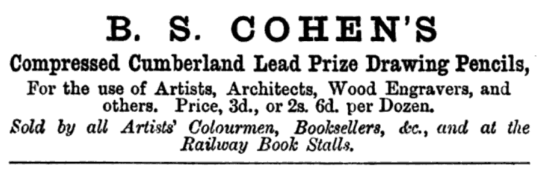
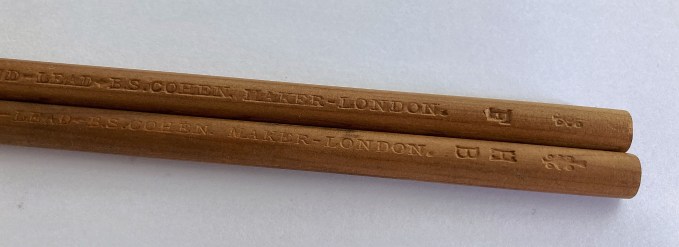
Today we are looking at an absolute classic of the Cohen range and a real oldie, the 1861 debuted ‘Compressed Cumberland Lead Pencil’.

The Compressed Cumberland Lead Pencils were made by hand. The graded slips of compressed lead were placed in the cavity between the two pieces of cedar barrel. When traditional solid graphite was used, a pencil would usually have 3 or 4 smaller pieces inside it making up the pencil. This could lead to inconsistencies in grade and smoothness. Cohen’s boast was a pencil ‘unvarying in its degree throughout‘. The graphic below was from an 1862 advertisement for the pencils.

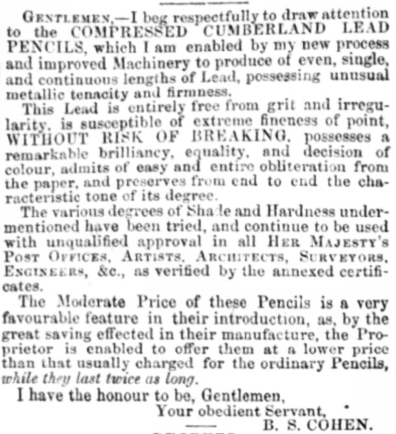
Cohen was starting to advertise his new pencils in late 1861 but I don’t think they hit the shelves until the next year. On 5 October Cohen himself put out a rather eloquent explanatory advertisement in the Edinburgh Evening Courant. Lets take a read at his explanation for this new invention:
It seems like Cohen’s early advertising attempts included sending samples out to reputable artists, museums and government institutions in the hope of getting some favourable reviews. An early example of influencer advertising perhaps?
The advertisement from the Dublin Builder, 1 November 1861 sets out a number of examples of this. I’ve seen many more examples but it would be a bit repetitive to include them all within this post.

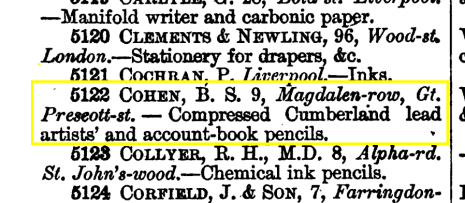
 I was able to track down a copy of the 1862 International Exhibition Official Catalogue and sure enough, Cohen’s Compressed Cumberland lead pencils were exhibited.
An advertisement from the 1862 exhibition notes that the lead is manufactured from the ‘far-famed Borrowdale plumbago‘. The beauty of Borrowdale plumbago was that not only was it rich in colour and remarkably smooth, but it also possessed the quality of ‘rubbing out readily without leaving a trace‘. Other qualities of these pencils were supposedly their excellent point retention and lack of degradation due to extremes of heat, cold or damp.

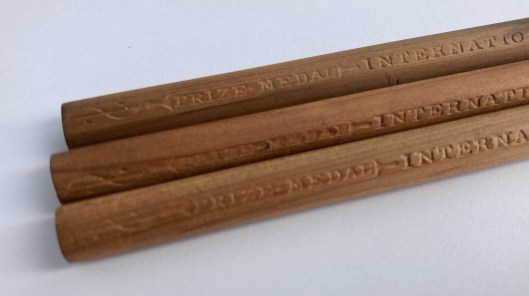
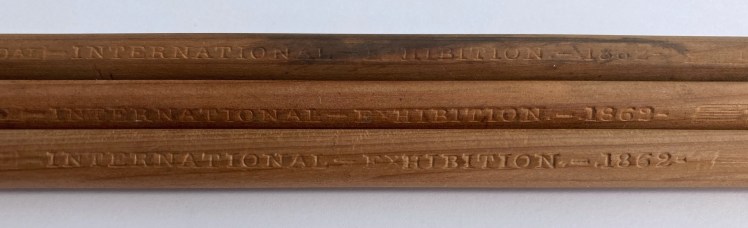
The pencils appear to have done well at many of the major exhibitions, even winning medals at a number. The examples I have dedicate an entire side of the pencil to celebrating their prize medal at London 1862.

Cohen also exhibited at the 1967 Universal Exhibition in Paris and the Official Report gives a nice explanation on the ‘Compressed Cumberland Lead’ formulation.
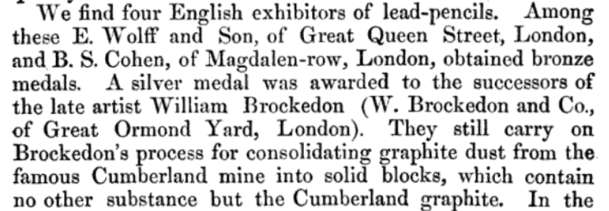
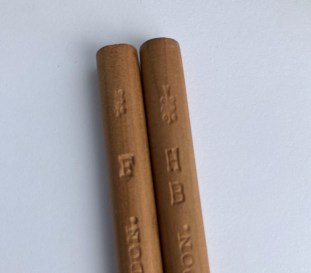
There was an interesting court case between Brockedon and Wolff over who came up with the process first; we will come back that on the blog shortly. One of the benefits of the compressed lead process over using solid pieces of graphite was the ability to have greater precision over the gradings. The examples I have come in F and HB.
 We can see from the below table that they came in a good range of degrees.
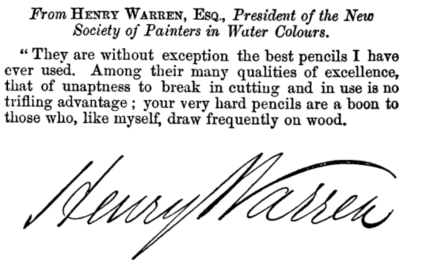
 Cohen opted to use testimonials as part of their advertising campaign (as was popular at the time). The testimonial from the President of the New Society of Painters in Water Colours hinted to both the point retention and quality of lead across the grades:
I don’t know much about historical UK trademarks, but according to Wikipedia, in 1862 the Merchandise Marks Act made it a criminal offence to imitate another’s trade mark “with intent to defraud or to enable another to defraud“.

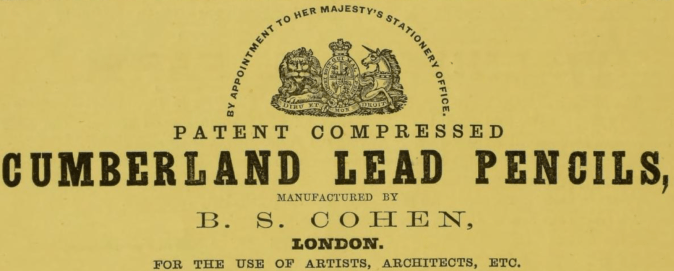
Cohen were quick off the mark, adding the ‘Trade Mark’ wording to both their advertising (above) and on their new Compressed Cumberland Lead pencils themselves (below).

These pencils came in a box with a number of other oldies; stay tuned for some other early examples.


 pencilfodder.com
Leave a reply to Alan Price Cancel reply